


Guarding the Canopy: Leveraging Giant Sequoia Lessons to Build Climate-Resilient Legacies in South-Central PA
Updated: Oct 13
Refer to our first two blog posts in this three-part series, "The Majesty of Giant Sequoias & Their Relevance to Franklin County, PA" and "How Sequoias Highlight the Importance of Tree Stewardship," to gain additional background on our journey through Sequoia and Kings Canyon National Parks.
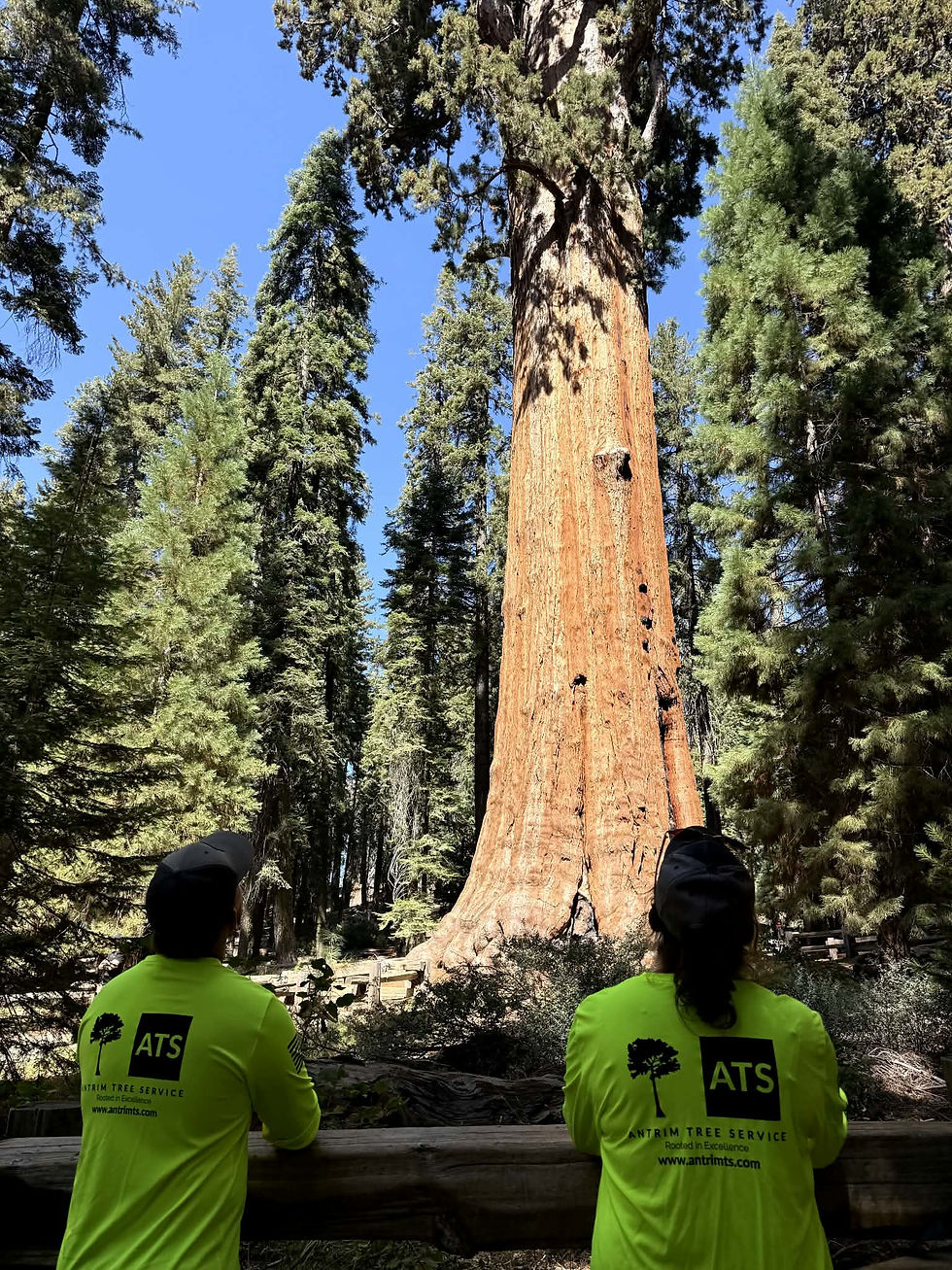
To wrap up our series, we are stepping back into the heart of the Giant Forest—specifically the awe-inspiring groves surrounding General Sherman and the tranquil, sunlit edges of Crescent Meadow. By looking closely at how giant sequoias survive centuries of severe mountain weather, homeowners, estate caretakers, and business managers can discover how to build true, long-term climate resilience for our local Pennsylvania landscapes, especially in the wake of Franklin County’s recent severe high-wind storms.
Standing Among the Council: The Power of Interconnected Root Systems
When you walk the pathways of the Giant Forest, you encounter more than just isolated individual trees. You find yourself standing in the middle of massive, tight-knit biological communities.
Near the world’s largest living tree, the General Sherman, lies a famous cluster of giants known as the Congress Trail. Walking this loop brings you face-to-face with spectacular tree groupings named The House and The Senate, alongside towering single sentinels like the McKinley, President, and Chief Sequoyah trees.

Seeing these ancient giants standing shoulder-to-shoulder highlights a profound truth about tree care: trees thrive best when they are managed as interconnected systems, not just isolated objects.
In the wild, these clusters share a massive, woven mat of shallow roots. When fierce mountain gales rip through the Sierra Nevada, these trees do not face the brunt of the weather alone. They break intense winds for one another, stabilize the soil as a collective unit, and damp the physical forces of the storm.
The Franklin County Connection:
Recent severe high-wind storms across Franklin County have left many property owners dealing with uprooted trees, broken canopies, and property damage. Too often in our local residential layouts, we treat trees like standalone lawn ornaments. A solitary prize tree standing completely exposed in the middle of a heavily mowed, compacted lawn bears the full force of severe wind gusts alone.
To build climate resilience, we need to think like a forest. Whether you are managing a suburban backyard, a historic estate, or a business landscape, consider planting and managing in groups. Designing your property to group trees, understory shrubs, and native groundcovers into shared, deeply mulched planting beds creates a unified windbreak. By establishing a shared root zone free from lawnmower compaction, you give your trees the collective structural anchoring they need to survive our increasingly volatile local weather.
Lessons from Crescent Meadow: Managing Our Local Giants
A short trip from the Sherman grove brings you to Crescent Meadow, a beautiful, lush green opening ringed by ancient sequoias. It is a place where deep forest meets open sunlight.

The trees lining the edge of Crescent Meadow enjoy abundant sunlight, but they also face unique environmental stressors. They take the absolute brunt of heavy winds and changing moisture levels that never penetrate into the deeper woods. Yet, they remain extraordinarily resilient because their root zones remain protected from human disruption.
The Franklin County Connection:
Most developed yard and estate trees in communities like Greencastle, Chambersburg, or Waynesboro are "edge trees." They sit on the border lines between open, sunny spaces (lawns, driveways, fields) and developed structures.
In South-Central Pennsylvania, we are blessed with magnificent native giants that thrive beautifully when given the proper site conditions. To maximize storm resilience, local stewards should focus on highlighting three premier regional species:
Eastern Sycamore: Perfect for low-lying, damp areas of a property. Its massive root system mimics the water-loving nature of wild sequoias and stabilizes wet soils against erosion.
White or Red Oak: The ultimate canopy anchors. Oak wood is incredibly dense, and when properly maintained, its broad structural canopy can distribute massive wind and ice loads.
Black Walnut: Known for its deep taproot and resilient wood structure, making it highly capable of standing firm against intense summer gales.
Because these native giants live on our developed edges, they require purposeful human intervention to stay healthy. They don't have a national park protecting their ecosystem, so they rely entirely on your proactive management.
The Climber’s Perspective: Shaping a Canopy to Distribute Wind Loads
As arborists who regularly climb high into the canopies of mature local hardwoods, we view trees from a unique perspective. When you are suspended 60 feet in the air inside a massive Oak or Sycamore, you gain a deep respect for tree physics. You can feel how the tree moves, bends, and absorbs energy.
When severe storms hit a tree with a dense, unmaintained canopy, the entire above ground portion of the tree is pushed by the wind. If the tree provides too much wind resistance, it creates tremendous torque that can snap large limbs or uproot the tree entirely. Learn more about tree care benefits in the following blog posts.

From our perspective up in the canopy, proper structural pruning isn't about shortening a tree or "topping" it—which actually ruins its structure. Read more about The Importance of Professional Tree Pruning vs Tree Topping. True stewardship means executing deliberate, professional structural pruning to eliminate weak attachments, deadwood, co-dominant stems, and reduce over-extended limbs. This opens up the canopy just enough to allow high winds to pass safely through the branches, protecting both the tree and your home or property below.
Your Number One Action Step: The Digital Tree Care Plan
The trees we admire today on the Congress Trail—from the President tree to the Chief Sequoyah—have stood for thousands of years because their environment allowed them to grow slowly, steadily, and without artificial disruption.
To replicate this success on your property, the single most effective action step you can take today is to establish a long-term Tree Care Plan paired with annual reminders on your digital calendar. Just as you schedule routine maintenance for your home or vehicles, your living canopy requires timed care to minimize the risk of structural failure.
Open up your digital calendar and set recurring annual reminders for these critical checkpoints:
Early Spring (March/April): Pest & Disease Inspections. Look for signs of overwintering pests or early fungal issues before the canopy fully leafs out.
Late Spring (May): Mulching & Fertilizing. Apply a 2-to-3-inch layer of organic wood mulch in a wide circle around the base (keeping it away from the bark) to simulate a forest floor and protect roots from summer heat.
Late Summer (August): Moisture & Soil Assessment. Check soil compaction levels and ensure deep watering protocols are in place if the region hits a seasonal drought.
Late Fall / Winter (November–February): Professional Pruning Assessments. The dormant season is the absolute best time for a climbing arborist to evaluate branch architecture, clear out storm-damaged limbs, and perform structural reductions or removals while the leaves are gone.
Build Climate-Resilient Trees with Antrim Tree Service
At Antrim Tree Service, our time exploring the unmatched beauty of Sequoia and Kings Canyon National Parks completely solidified our core philosophy: #RootedInExcellence. We bring that exact same passion, respect, and climbing expertise back to the properties of Franklin County.
If recent high-wind storms have left you worried about the safety of the mature Sycamores, Oaks, or Walnuts on your property, don't wait for the next severe weather event. Our team specializes in comprehensive tree management, routine maintenance, and long-term canopy stewardship for homeowners, estate caretakers, and business managers alike.
Let’s work together to make your property's canopy as vibrant, resilient, and storm-ready as a protected national grove.
👉 Ready to establish your property's climate resilience? Give us a call today at 814-386-4236, or visit us online at antrimts.com to book your free, no-obligation tree care estimate through our online portal.


Comments